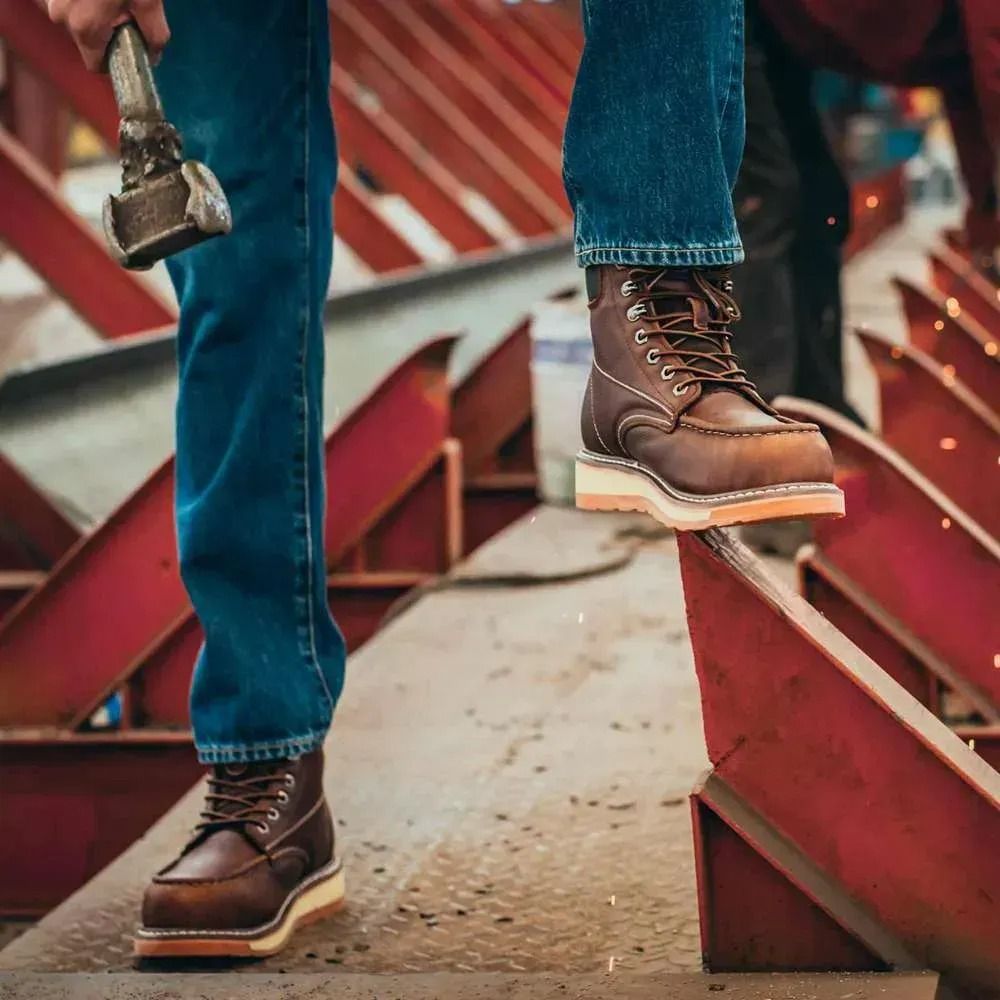
In the vast ecosystem of the modern job site, few surfaces are as ubiquitous—and as physically punishing—as reinforced concrete. For the masons, finishers, and laborers who build our infrastructure, concrete is the canvas. But from a biological perspective, concrete is a rigid, unyielding adversary. Unlike natural soil or timber, concrete possesses a high "rebound" factor. Every step taken on a finished slab sends a micro-shockwave through the heel, up the tibia, and into the lumbar region of the spine.
As we progress through 2026, the industrial workforce is moving away from the "tough it out" mentality of previous generations. There is a growing recognition that the human body is an asset that requires the highest level of technical protection. Finding the most comfortable work boots for walking on concrete all day is no longer a luxury; it is a fundamental requirement for career longevity and orthopedic health.
The Biomechanics of "Concrete Fatigue"
To select the right footwear, one must understand the physics of the environment. In kinematics, we look at "ground reaction force." When you walk on a forgiving surface, a portion of the energy from your foot strike is absorbed by the ground. Concrete, however, reflects nearly 100% of that energy back into your musculoskeletal system.
Over a twelve-hour shift, this leads to a cumulative stress load that manifests as plantar fasciitis, chronic knee inflammation, and "pedal fatigue." The solution lies in the midsole. Modern specialized concrete work boots utilize advanced high-rebound Polyurethane (PU) midsoles. Unlike the EVA foam found in traditional sneakers—which tends to compress and "bottom out" under the weight of heavy tool belts—industrial-grade PU maintains its structural memory for years, providing consistent shock attenuation from the first hour to the last.
The Chemical War: Why Cement Eats Leather
Masonry is uniquely hazardous to footwear because it isn't just a physical challenge; it’s a chemical one. Wet mortar and cement are highly alkaline. These substances are "hydroscopic," meaning they actively seek out and draw moisture and natural oils from any organic material they touch.
When wet cement splashes onto standard leather, it leaches out the tanning oils that keep the fibers supple. Once the leather dries, it becomes brittle and prone to "alligator cracking" at the flex points. For a professional mason, the integrity of the upper is as important as the safety of the toe.
The Solution: Oil-Tanned Full-Grain Leather To combat chemical degradation, professional-grade boots are crafted from full-grain leather that has been deep-saturated with oils and waxes during the tanning process. This creates a natural barrier that prevents cement milk from penetrating the hide. Furthermore, utilizing fully seam-sealed waterproof boots ensures that even in wet-pour conditions, the caustic chemicals in the concrete slurry cannot reach the skin, where they can cause "cement burns" or severe dermatological irritation.
Outsole Engineering: The Traction Equation
On a masonry site, the floor is rarely just concrete. It is concrete covered in fine dust, wet slurry, or loose sand. This makes slip resistance a critical safety metric.
In 2026, footwear manufacturers are utilizing dual-density rubber outsoles. The outer layer is a hard-wearing compound designed for abrasion resistance against rough bricks and stone. The inner contact points utilize a softer "tacky" rubber that provides a high coefficient of friction on smooth surfaces.
The Wedge Sole Advantage: Many masons prefer a wedge (flat) sole because it provides 100% surface contact. This eliminates the "heel-snag" hazard when navigating scaffolding and ensures that weight is distributed evenly across the foot, which is vital for maintaining balance while carrying heavy masonry units.
Siping: Look for tread patterns with micro-grooves (siping). Much like a high-performance rain tire, these channels move liquids away from the contact patch, allowing the rubber to grip the solid surface beneath.
Safety Standards: Steel vs. Composite in Construction
On any commercial site, a safety toe is a non-negotiable requirement. However, the choice between materials often depends on the specific "micro-climate" of the work.
1. The Steel Toe Standard
Steel remains the choice for those in high-impact zones. It offers the thinnest profile, allowing for a more aerodynamic boot design while providing maximum crush protection. Modern steel caps are anatomically shaped to prevent the "toe-pinch" common in older designs, especially during the deep squats required for ground-level masonry work.
2. The Composite Toe Innovation
Composite safety toes—made from carbon fiber or high-strength resins—are the choice for professionals working in extreme temperatures. Because composite is non-metallic, it does not act as a thermal bridge. In the winter, it won't draw heat away from your toes; in the summer, it won't bake them. This thermal regulation is a key comfort feature that reduces the risk of numbness and improves circulation.
Maintenance: Honoring the Investment
A high-quality pair of boots is a tool, and like any tool, it requires maintenance to perform at its peak. For those working with concrete, the "after-shift" routine is essential.
The Daily Rinse: Use a stiff brush and clean water to remove all traces of wet mortar or cement dust before it hardens. Once cement cures on leather, it is nearly impossible to remove without damaging the grain.
Conditioning: Apply a silicone-based or heavy-duty oil conditioner every few months. This "feeds" the leather, replacing the oils that the environment has leached out.
Rotation: If possible, do not wear the same pair of boots two days in a row. It takes 24 to 48 hours for the internal foams and leather to fully release the moisture from your sweat. Rotating between two pairs of concrete work boots can more than double the lifespan of both.
Your Most Important Piece of PPE
In the landscape of 2026 industrial labor, we are only as efficient as our foundation. Masonry is a trade of precision and endurance. By selecting footwear that addresses the biological toll of concrete impact, the chemical aggression of mortar, and the ergonomic needs of the active foot, you are making an investment in your own future.
The right pair of boots doesn't just protect you from a falling brick; it protects you from the quiet, cumulative injuries that sideline so many veterans of the trades. Choose a boot that respects your craft and your body. Stand strong, stay dry, and keep your focus on the wall, not the pain in your feet.